Our story
What began with a prototype by a handful of Melbourne architects has grown into a revolutionary housing model that responds to persistent problems of affordability and helps accelerate the pace of sustainable development toward a low-carbon future.
664
Homes delivered
28
Homes under construction
499
Homes in planning
All numbers as of December 2025
Beginnings
In 2007, our founders Jeremy McLeod, Tamara Veltre, and their team at Breathe looked across their city and saw that housing was environmentally unsustainable, badly designed, and poorly built. They knew it could be better. Their response was to purchase a site in Brunswick and create the building that would become the prototype for Nightingale: The Commons, completed in 2013.
Breathe wanted The Commons to be their first architect-funded project, but these plans were upended by the impacts of the Global Financial Crisis. Ethical developers Small Giants came on board to support the project, seeing it through to completion in 2013.
The Commons gained widespread attention and won a 2014 National Architecture Award for Housing and a National Architecture Award for Sustainability. It also saw thousands of Melburnians pass through its doors on public tours. Crucially, it demonstrated a clear demand for quality medium-density housing. To respond to that demand, Nightingale Housing was born.
The Nightingale vision was for a new housing system. It was about building homes, not real estate as a commodity. It was about fostering community to combat rising social isolation, and designing buildings that positively tackled the issues of climate change rather than adding to the problem.
Nightingale 1
With a vision to create a new Nightingale building, Breathe purchased the site across the street from The Commons in 2014. They then raised investor funds from leading Melbourne architects Architecture Architecture, Austin Maynard Architects, Clare Cousins Architects, MRTN Architects, Six Degrees Architects and Wolveridge Architects along with 17 other impact investors.
Like its precursor, Nightingale 1 went on to receive a National Architecture Award for Housing and a National Architecture Award for Sustainability. It was the first residential building to win the Melbourne Prize.
Nightingale gains independence
In 2016, Nightingale became a separate entity from Breathe. Since then the organisation has continued to grow, with hundreds of current and future Nightingale residents in Melbourne, as well as in regional Victoria, Adelaide, Sydney and Perth.
Although the motivation of the company had always been to design ‘for people, not profit’, the board opted for a social enterprise structure over a not-for-profit, understanding that this would be more compelling to much-needed project investors.
In April 2021, Nightingale returned to its roots and achieved not-for-profit status, enshrining the ethos of the founders and directors in perpetuity.
Nightingale today
Our goal was always to become a charity. In 2025, we achieved that goal and transitioned from a not-for-profit organisation to a charitable entity.
We have come a long way since Nightingale Housing formed in 2016, with hundreds of current and future Nightingale residents joining our growing community in Melbourne, as well as in regional Victoria, Adelaide, Sydney and Perth.
Since we began, our aim has been to lead by example, reorienting the housing market to focus on good housing outcomes for those historically locked out of home ownership. To help those most in need, we aim to allocate up to 20% of our housing to community housing providers.
The future of Nightingale
Nightingale cares deeply about the experience of our residents and the outcomes for our communities. With our mission-driven team, we work tirelessly towards realising the Nightingale vision: an Australia where housing is socially, financially and environmentally sustainable.

Nightingale acknowledges that we build on land which was stolen from First Nations peoples and that we operate in an economy bound by systemic racism. We feel it’s our responsibility to respect the rights of all people, which compels us to act to help end this inequality and racism. We recognise the role we play in turning our intentions into clear actions through our Reconciliation Action Plan (RAP). Thank you to Viviana Sacchero who provided project management on our RAP.

Federal Minister for Housing, The Hon Clare O'Neil with local member Peter Khalil at Nightingale Wurru wurru biik, 2024

Grand Designs host, Kevin McCloud tours Nightingale Village, 2024

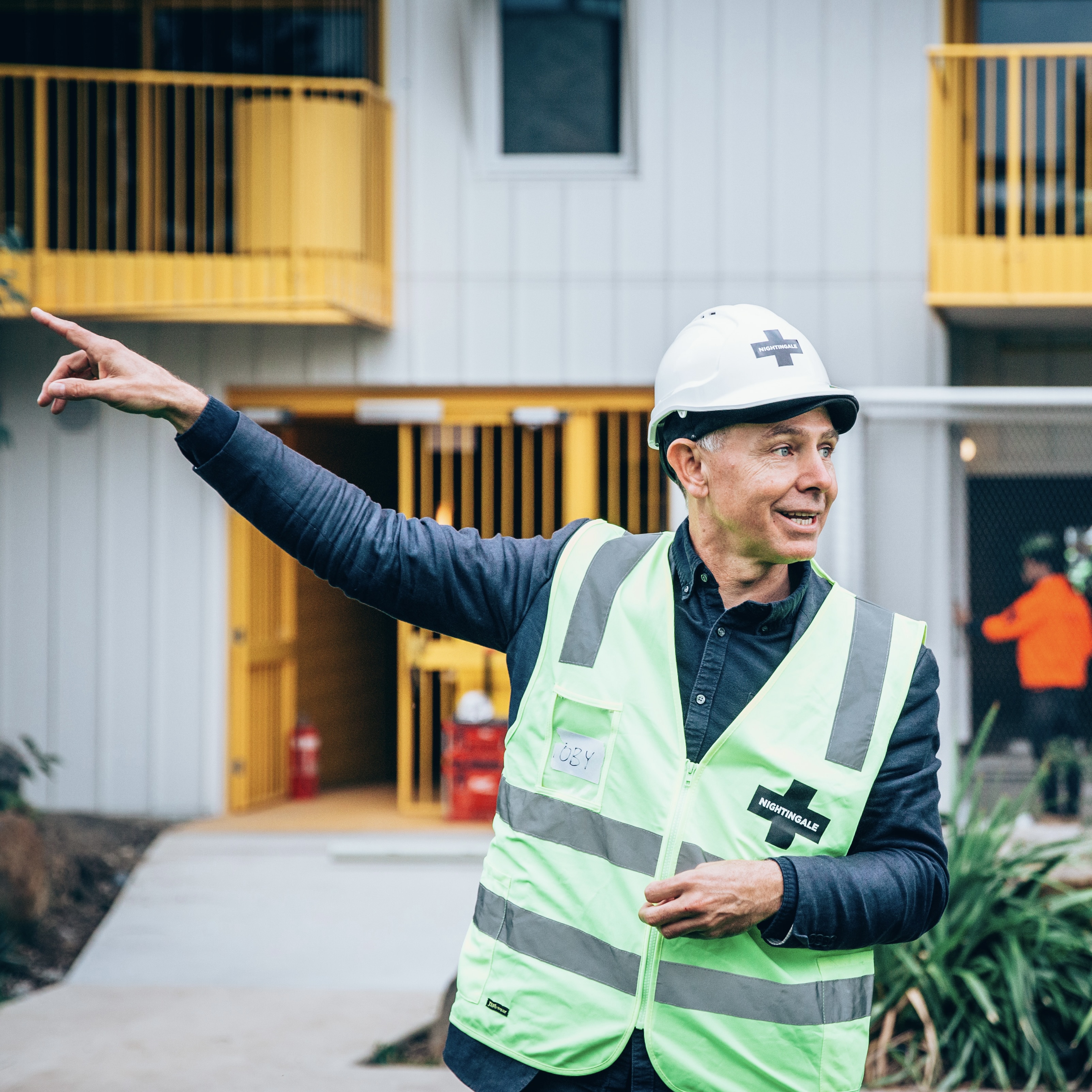
Head of Community, Toby Dean at the Nightingale Village and Nightingale Anstey welcome celebration at Bulleke-bek Park, 2022

Welcome to Country by Jack Buckskin at Nightingale Bowden opening celebration, 2022

Nightingale Housing hosting an MTalk as part of MPavilion's 2024 summer program.